VectorMesh – Designing a High-Traffic, Secure-by-Design Enterprise AI-RAG Platform
TL;DR
This article explores the architecture and engineering decisions behind VectorMesh, an enterprise-grade AI-RAG (Retrieval-Augmented Generation) platform designed to address the bottlenecks that emerge when AI systems move from experimentation into production.
The platform is built around Rust-based microservices, Kubernetes, Istio, Apache APISIX, and end-to-end observability, with a strong focus on scalability, security, performance, and operational visibility.
The Problem: Why Generic AI Solutions Fall Short in Enterprise Environments
Organizations are rapidly adopting AI and LLMs to analyze internal data and automate business workflows. However, turning an AI prototype into a production-ready enterprise system introduces a different class of engineering challenges.
Some of the most common problems include:
- Security & Privacy: Sensitive enterprise data must remain protected, while internal service-to-service communication needs to be encrypted and authenticated.
- Scalability: Systems can become unstable under high concurrency, particularly during computationally intensive operations such as text embedding.
- Observability Blind Spots: As the architecture grows into multiple distributed services, identifying the source of latency or failures becomes increasingly difficult without end-to-end visibility.
These challenges require more than simply integrating an LLM. They require an architecture designed for production from the ground up.
The Solution: VectorMesh Architecture
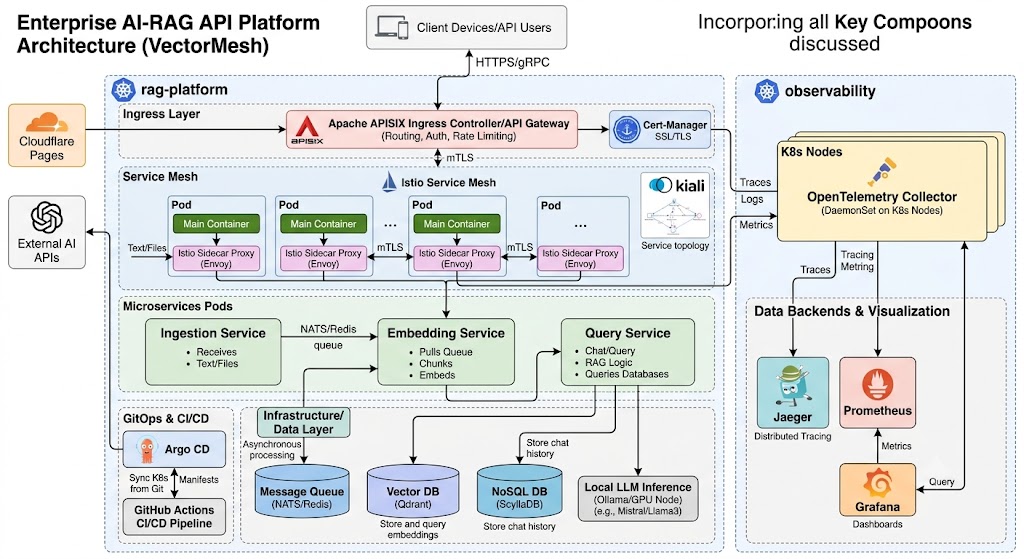
To address these challenges, I designed VectorMesh as a cloud-native API platform, with clear separation between system components and workloads.
The architecture follows a decoupled, independently scalable design, allowing each service to scale according to its own workload characteristics rather than scaling the entire system as a single unit.
Below are the core engineering decisions behind the platform.
1. High-Performance Backend with Rust
The core backend microservices—including Ingestion, Embedding, and Query Services—are implemented in Rust and structured around Clean Architecture principles.
The decision to use Rust was not driven solely by raw execution speed or low latency.
A major consideration was predictable and efficient memory management, which allows CPU and RAM resources to be utilized more efficiently in cloud environments.
This directly contributes to cost optimization, particularly for workloads where infrastructure efficiency has a significant impact on operational cost.
The architecture is therefore designed not only for performance, but also for efficient resource utilization at scale.
2. Data Layer: Separating Storage Responsibilities for Higher Throughput
A production-grade RAG system needs to efficiently handle both high-volume vector retrieval and persistent conversation data.
To avoid coupling these workloads, I separated the data layer into purpose-built storage systems.
Vector Database – Qdrant
Qdrant is responsible for storing and searching vector embeddings.
This separation allows the platform to optimize vector retrieval independently from other application data and focus specifically on delivering relevant context to downstream AI workflows.
Chat History – ScyllaDB
ScyllaDB is used to store chat history and large-scale operational records.
The data model follows a CQL schema optimized around access patterns and a no-join design, prioritizing predictable read/write performance and horizontal scalability.
This separation of responsibilities allows each storage technology to be optimized for its specific workload rather than forcing a single database to handle fundamentally different access patterns.
3. Secure Infrastructure & Service Mesh
Security is a first-class design requirement in VectorMesh rather than an additional layer added after the application is built.
Ingress Gateway
Apache APISIX serves as the external API gateway and provides the entry point for the platform.
It is responsible for capabilities such as:
- Request routing
- Rate limiting
- Authentication
- Traffic management
TLS certificate management is handled through cert-manager, using the appropriate solver configuration based on Kubernetes ingress class parameters to avoid deprecated configuration patterns.
Zero-Trust Network
Inside the Kubernetes cluster, Istio Service Mesh provides service-to-service security using strict mutual TLS (mTLS).
This ensures that communication between microservices is encrypted and authenticated by default, establishing a Zero-Trust networking model within the cluster.
Rather than relying solely on application-level security, the infrastructure itself enforces secure communication between services.
4. Observability: End-to-End Visibility with OpenTelemetry
A reliable system is one that can detect and explain problems before customers have to report them.
VectorMesh integrates OpenTelemetry (OTel) throughout the application stack to provide metrics and distributed tracing across services.
Traces are exported to Jaeger, allowing individual requests to be followed across the entire service chain.
For example, when a request experiences unexpected latency, engineers can inspect the distributed trace and determine whether the bottleneck occurred within:
- the Embedding Service,
- the Query Service,
- database operations,
- or another downstream dependency.
This turns troubleshooting from guesswork into an observable, measurable engineering process.
Business Impact & Conclusion
The architecture behind VectorMesh is not intended to be a collection of technology buzzwords.
Every component is selected to solve a specific engineering or operational problem.
Resilience
Workloads can be independently auto-scaled based on actual demand, allowing high-load components to scale without unnecessarily scaling the rest of the platform.
AI inference workloads can also be isolated and deployed on Spot Instances where appropriate, helping reduce infrastructure costs.
Maintainability
The combination of Clean Architecture, decoupled services, and comprehensive observability provides clearer system boundaries and significantly improves the team’s ability to diagnose and maintain the platform.
Engineering Discipline
VectorMesh is built around the same principles I apply to production engineering in general:
- Performance and resource efficiency
- Security by design
- Clear architectural boundaries
- Observable and operable systems
- Automated CI/CD
- GitOps-based delivery
- Scalable cloud-native infrastructure
Ultimately, VectorMesh represents more than an AI-RAG implementation. It is an example of how AI workloads can be engineered as production-grade infrastructure—with scalability, security, observability, and operational efficiency treated as first-class concerns from the beginning.